
Navigating busy city streets has become increasingly challenging for British drivers. With narrow lanes, frequent lane changes, and cyclists weaving through traffic, urban driving demands constant awareness. Many drivers have discovered a simple yet effective solution that has dramatically improved their confidence behind the wheel: blind spot mirrors.
Real Stories from British Drivers
Sarah Matthews, a London commuter, recalls her experience before installing blind spot mirrors on her Ford Focus. “I was constantly nervous about changing lanes on the A4. You just can’t see everything with standard mirrors, especially when buses and lorries create these massive blind zones.” After fitting small convex mirrors to her existing wing mirrors, Sarah noticed an immediate difference. “The first time I used them in heavy traffic near Hammersmith, I spotted a cyclist I would have completely missed otherwise. It was a real eye-opener.”
Manchester taxi driver David Chen has been using blind spot mirrors for three years. His daily routes through the city centre convinced him these small accessories are essential. “In urban environments, you’re dealing with pedestrians, cyclists, and other cars constantly moving around you. These mirrors give you that extra field of vision that makes all the difference. I’ve prevented several potential accidents since installing them.”
The common thread among drivers who use these mirrors is increased confidence. The Blind Spot Mirror is a very affordable, cost-efficient way to improve driver safety by allowing you to see what’s in your blind spot without turning your head. This feature proves particularly valuable in stop-and-go traffic where quick head movements can be dangerous.
Understanding Blind Spot Mirror Technology
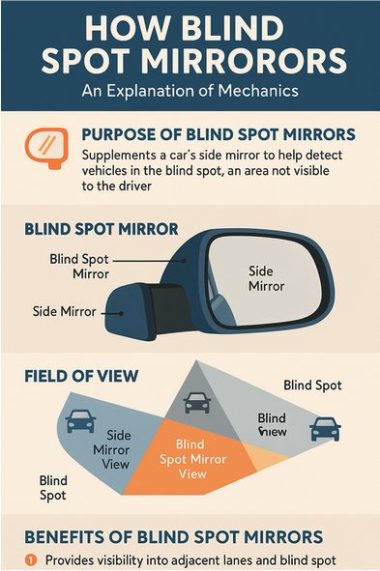 Standard car mirrors leave significant gaps in visibility. The area directly beside your vehicle, typically extending from the rear quarter panel to just forward of the driver’s position, remains hidden from view. Blind spot mirrors address this problem through their convex design, which captures a wider field of vision than flat mirrors.
These small, curved mirrors attach to the outer edge of existing side mirrors. Their positioning allows drivers to see vehicles, cyclists, and pedestrians that would otherwise be invisible. The convex surface compresses the image, fitting more of the surrounding area into the mirror’s surface. While objects appear smaller and farther away than they actually are, experienced users quickly adapt to judging distances accurately.
The mechanics are straightforward but effective. When a vehicle enters your blind spot, it disappears from your standard mirrors but remains visible in the blind spot mirror. As the vehicle moves parallel to your car, you can track its progress without turning your head. This continuous monitoring proves crucial during lane changes, merging, and turning manoeuvres.
As the infographic demonstrates, blind spot mirrors supplement your car’s standard side mirror system by providing visibility into adjacent lanes and areas not visible to the driver. The field of view comparison clearly shows how these mirrors eliminate dangerous blind zones, creating a comprehensive visibility solution that significantly enhances driving safety.
Safety Benefits for City Navigation
City driving presents unique challenges that make blind spot mirrors particularly valuable. These small mirrors are especially helpful when driving in urban environments, dual or single carriageway and motorway, where you could accidentally miss seeing vehicles in your blind spot.
Traffic density in urban areas means vehicles frequently occupy blind spots. Traditional mirror checking methods require head movements that take eyes off the road ahead. In congested traffic, these brief moments of inattention can lead to rear-end collisions. Blind spot mirrors eliminate this problem by providing continuous peripheral vision monitoring.
Cyclists represent another significant urban challenge. They often travel at speeds that place them in blind spots for extended periods. The combination of their smaller profile and variable speeds makes them particularly difficult to spot using standard mirrors alone. Blind spot mirrors significantly improve cyclist detection, reducing the risk of dangerous side-swipe incidents.
Parking situations also benefit from enhanced visibility. Tight urban parking spaces require precise manoeuvring, and blind spot mirrors help drivers spot obstacles, pedestrians, and other vehicles that might otherwise cause damage. This improved awareness helps protect vehicle components from costly scrapes and bumps, particularly when considering information about car bumpers from autodoc.co.uk and other vulnerable parts that are prone to parking damage.
Simple Setup and Positioning Guide
Most blind spot mirrors use strong adhesive backing for permanent attachment to existing mirrors. The installation process takes minutes and requires no tools. Proper positioning is crucial for maximum effectiveness. The mirror should be placed on the outer edge of the side mirror, positioned to capture the blind spot area without blocking the main mirror’s view.
Testing the positioning involves sitting in the driver’s seat and adjusting the mirror angle to maximise the blind spot coverage. The goal is to create a seamless transition between what’s visible in the main mirror and what appears in the blind spot mirror. Some drivers prefer slightly overlapping coverage to ensure no gaps remain.
Research-Backed Safety Evidence
Road safety experts emphasise the importance of comprehensive visibility for all drivers. Expert opinion from AUTODOC, “Road users are always in danger when they are next to turning cars because they may be completely invisible, especially to truck or bus drivers.” This observation highlights why enhanced visibility tools like blind spot mirrors are essential for protecting all road users.
Blind-spot mirrors have already helped reduce the number of accidents involving lorries and motorcyclists, cyclists or pedestrians. This evidence from European road safety data demonstrates the real-world impact these simple devices can have.
Proven Results and Statistical Analysis
Recent studies reveal compelling evidence about the effectiveness of blind spot monitoring systems. The Insurance Institute for Highway Safety (IIHS) examined the effectiveness of anti-blind spot technology in police-reported lane-change collisions. The organization found that blind spot monitoring reduced crashes of all severities and with injuries by 14% and 23%, respectively.
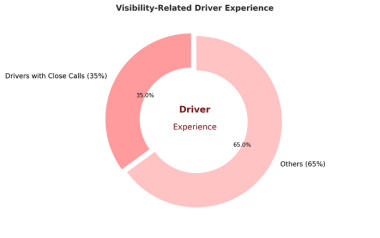
The impact extends beyond simple collision reduction. 35% of drivers had close calls due to limited visibility, highlighting the widespread nature of blind spot-related incidents. For commercial vehicles, the benefits are even more significant. The results revealed that the system would reduce the number of warnings with vulnerable road users by one third for heavy goods vehicles and 10% for buses. Up to 200 lives annually could potentially be saved with the analysed system.
Interactive Safety Statistics
The following comprehensive analysis demonstrates the measurable impact of blind spot monitoring technology on road safety:
Key Safety Data Points
The data paints a clear picture of improved road safety:
- 14% reduction in all lane-change crashes with blind spot monitoring
- 23% reduction in injury-causing lane-change accidents
- 35% of drivers experience close calls due to poor visibility
- Up to 200 lives could be saved annually with comprehensive blind spot systems
- 70% of reversing accidents could be prevented with proper visibility equipment
These statistics demonstrate that even simple blind spot mirrors can contribute significantly to road safety improvements. While the studies often focus on electronic systems, the fundamental principle of enhanced visibility applies equally to traditional convex mirrors.
Affordability Meets Effectiveness
Compared to advanced driver assistance systems, blind spot mirrors represent an extremely affordable safety upgrade. A quality set costs less than £20, while electronic blind spot monitoring systems can cost hundreds of pounds to install. For drivers of older vehicles or those seeking immediate improvement, blind spot mirrors offer exceptional value.
The durability of these mirrors means they typically last several years with minimal maintenance. Regular cleaning ensures optimal visibility, and the adhesive backing generally withstands weather extremes and car washing.
Taking the Next Step Forward
For drivers considering blind spot mirrors, the transition period requires some adjustment. The convex surface initially feels unfamiliar, and judging distances takes practice. However, most drivers adapt within days and quickly recognise the safety benefits.
Urban driving no longer needs to feel like navigating a maze blindfolded. With blind spot mirrors providing enhanced visibility, drivers can move through city traffic with greater confidence and safety. The combination of affordability, easy installation, and proven effectiveness makes them an essential addition to any vehicle operating in busy environments.
The testimonials from drivers like Sarah and David reflect a common experience: once you’ve driven with blind spot mirrors, returning to standard mirrors feels like driving with one eye closed. For the safety of everyone sharing Britain’s busy roads, that enhanced visibility proves invaluable.
Written by Alena Kirsanova